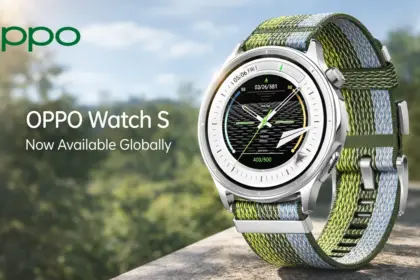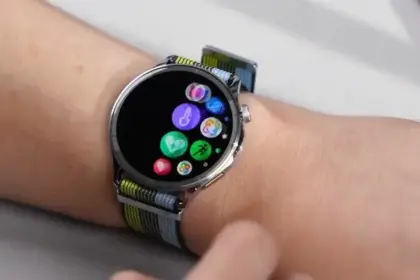
Europe is now able to get the Oppo Watch S. The smartwatch is comparatively tiny, has a very brilliant display, and is said to be able to determine lactate levels.
Last fall, Oppo unveiled the Watch S, a wearable that has now made its way to Europe. The watch is available in Phantom Black and Nebula Silver, and Oppo lists it for €259. The watch is already available for purchase on the company’s website in Austria, and it should soon be available in additional European nations. Some third-party retailers are already carrying the Oppo Watch S as well.
In order to improve readability in direct sunlight, Oppo is highlighting the display, which is built on a 464 x 464 AMOLED panel with a maximum brightness of 3,000 nits. As usual, this peak brightness is only available in brief bursts rather than continually. There is also an always-on mode, although the battery life will be reduced from seven to four days.
The smartwatch is partially composed of stainless steel and has a thickness of roughly 0.35 inches. Additionally, the Oppo Watch S is made to offer extra workout information, such the tennis swing speed. Oppo provides a posture assessment for running and jogging, and the smartwatch has the standard GPS module.
The Oppo Watch S will be released worldwide. It’s unclear if the smartwatch will live up to the expectations despite being advertised with extremely high brightness, an incredibly thin stainless steel shell, cross-OS dual-phone connection, and sensors meant to offer real-time data for health aficionados and aspiring athletes.
Since the wearable is now mentioned on the company’s worldwide website, a launch in additional markets is probably just around the corner. Oppo hasn’t yet disclosed any details on costs or precise release dates, though.
In essence, the Oppo Watch S is a feature-rich smartwatch that strives to dazzle with its display. Oppo specifies a maximum peak brightness of 3,000 cd/m². The AMOLED panel is 1.46 inches in diameter and has a resolution of 464 x 464. The gadget can be used while swimming without worrying about damage because it is waterproof up to a test pressure of 5 ATM. The inbuilt dual-band GNSS module should be advantageous to athletes as well.
Heart rate and oxygen saturation can be measured using optical sensors on board. Additionally, extensive and potent sleep monitoring features are promoted. Athletic activities can be recorded using more than 100 different sports profiles. The battery lasts four days when the display is always on, with an average lifespan of one week. For further information, prospective customers can visit the product site.
Oppo’s ColorOS is the operating system that has produced the most feature-rich Android skins. The user experience is now significantly enhanced by the AI tools. Now, Oppo users are looking forward to the release of ColorOS 16. The most recent version of Android 16 will serve as its foundation. More efficiency, more features. This post will be helpful if you are currently considering an Oppo phone, such as the forthcoming Find X9 series. Additionally, this post will assist you in determining whether your current Oppo phone is eligible for the update. Let’s dissect all the information we require.
ColorOS 16 release date and rollout
On October 15, 2025, the ColorOS 16 was most recently announced worldwide. It will make its debut alongside the upcoming Find X9 series. Regarding the current devices, they will also progressively get the update. For devices like the Find X8 Pro, beta versions have already begun to roll out in a number of countries, including Malaysia, Indonesia, and India. Most likely, the stable update will be released on October 30, 2025. However, it won’t be accessible in India right away. It will be initially applied to China’s flagship gadgets. In India, the first stable ColorOS 16 upgrade is anticipated in Q1 2026.
Therefore, in order to avoid the wait when purchasing a new phone, opt for models that come pre-installed with ColorOS 16.
ColorOS 16 Features
We may claim that the core of Oppo’s ColorOS 16 is “Smart & Smooth” performance. Thus, anticipate speedier daily tasks, simpler multitasking, and assistance for content production. This may indicate that you should get an Oppo cellphone running ColorOS 16 if you want AI integration and smoothness over standard Android.
Performance
Oppo has concentrated on creating a sense of instantaneity in interactions. This one also uses ColorOS 15’s Parallel Animation, albeit with a minor improvement. Seamless Animation is a new feature in ColorOS 16. Here, your touch point is the natural starting point for gestures and app transitions.
It is powered by some important technology, such as:
Luminous Rendering Engine: Renders visuals in parallel for lag-free animations.
Trinity Engine: Optimises resources for gaming and heavy tasks.
Tide Engine: Reduces power use (by 13%) and lowers temperature (by 4.1°C).
Overall, we get faster boot times, smoother app launches and scrolling, and quicker tap responses.
Ai integration
Whether you agree or not, AI has made a significant impact. incorporating time-saving and productivity-boosting tools? Bring it on! If you use your phone for artistic or professional purposes, it will be ideal.
AI One-Tap Flash Note: Captures and organises notes from documents, videos, or bills. Also, summarises videos into chapters and automates expense tracking.
Xiaobu AI Assistant: Offers personalised briefings (weather, tasks, news). Suggestions based on your habits, real-scene dialogues via voice/gestures. Gives portrait lighting for better photos.
Productivity suite: AI Recording for transcriptions, AI Writing for drafts (emails, docs), AI Notes for templates. There’s handwriting conversion, and AI Calendar for task timelines too.
ColorOS 16’s AI improvements are its highlights. Anyone who believes that these AI tools may simplify their life by taking care of routine duties ought to give this operating system a try.
Additionally, there are some similarities to Google’s Gemini integration. The only difference is that this one is customized for the Oppo environment.
UI and Customisation
An OS’s user interface and degree of customization reveal a lot about it. Natural light and shadows served as inspiration for the ColorOS 16. Gradients, halos, and glows are used in the design to create a simple, intuitive appearance.
The notable ones are as follows:
Flux Home Screen: Resize icons, folders, and cards dynamically. The layout adapts with fluid animations.
Full-Screen AOD: View your wallpaper with key info on the always-on display.
Personalisation: AI-generated themes, animated wallpapers from static images, and auto-matching icon colours.
Compared to many other competitors, these alternatives offer greater versatility if you enjoy playing with the look of your phone.
Photo and Video Editing
For people interested in photography, ColorOS 16 upgrades the Photos app with:
AI Portrait Glow: Enhances low-light portraits by optimising skin tones.
Other AI tools: Eraser, Unblur, and Reflection Remover.
Video editing: Master Cut for trimming, music, filters, and adjustments.
For those seeking effortless photography, some enjoyable settings include slow-motion effects, live collages, and collections of human and pet photos.
Cross-Device Connectivity
Seamless integration across ecosystems is a highlight:
O+ Connect: Manage files and remote control between phone, Mac, or Windows PC.
Screen Mirroring: Cast up to five apps and control with a mouse/keyboard.
One-Tap Share: Transfer docs, notes, and more, including health data from Apple Watch.
Additional benefits include PC-level WPS Office, vehicle connectivity, customizable control center, and floating windows for multitasking.
There will still be seamless connectivity between your various devices if you have a mixed Apple/Android configuration.
Find N3 series Find X7 series Reno14 series Reno13 series Pad 4 Pro Pad 3 Pro OnePlus 12 Ace 3/5 series Pad Pro
December 2025
Find N2 series Find X6 series K13 Turbo series OnePlus 11 Ace 2 series
Q1 2026
Find X5 series Reno12 / 11 / 10 / 9 series (select models) K13 / K12 series Pad 3 / 2 / SE OnePlus 10 Pro Pad series
Your device might not get ColorOS 16 if it isn’t listed (for example, if it’s older than Find X5 or Reno9). If you truly enjoy them, you might want to upgrade to the newest features.
ColorOS 16 vs ColorOS 15
Since the current OS update isn’t that old, many people wonder if it’s worthwhile to upgrade to the next one. Check out the distinctions between ColorOS 16 and its predecessor ColorOS 15 if you’re experiencing the same confusion:
AI One-Tap Flash Note, Xiaobu (Briefing, Dialogue, Lighting), AI Writing/Notes/Calendar
AI Editor (Clarity, Eraser), AI Toolbox, Gemini Integration
UI Customisation
Flux Home Screen, Full-Screen AOD, AI themes
Aesthetic upgrades, smoother icons/widgets
Performance
Tide Engine (13% less power), Project Breeze for entry-level
Snappy responsiveness, fluid multitasking
Cross-Device
O+ Connect (Mac/Windows), 5-app mirroring
Touch to Share (iOS), basic multitasking
Photo/Video
AI Portrait Glow, Master Cut
AI Eraser/Unblur, basic editing
For deeper AI and efficiency advantages, especially on older hardware, ColorOS 15 is a worthy upgrade.
Every Oppo user has been waiting for ColorOS 16’s level of novelty. It combines customization, AI tools, and performance in more than subtle ways. Because of this, it is an appealing option for upgraders or new purchasers. For the complete experience, think about smartphones like the Find X9 if you’re in the market. Or upgrade your current gadget to make it last longer. Keep checking back here for more information about devices that qualify.
Oppo officially announced that its Find X9 series will ship on October 16. Redesigned design elements, improved imaging, and notable battery improvements are all part of the new flagship lineup, which comprises the Find X9 and X9 Pro, according to information released on the company’s official channels.
Find X9 series key details revealed by Oppo ahead of launch
For comfortable handling, the Find X9 and Find X9 Pro come in 6.59-inch and 6.78-inch sizes with flat screens and symmetrical bezels that are incredibly thin. The rear panel of both smartphones has a sophisticated feel and a smooth grip thanks to its velvet sand finish.
The lens module and the back have been completely merged using cold carving technique, which minimizes any obvious connection lines. The display itself offers 3840Hz high-frequency PWM dimming for improved visual comfort in addition to a full-scene 1nit eye-care mode that is compatible with all apps.
The rear design of the Find X9 series has been made public for the first time in the brand’s latest pictures. The following shades will be offered for the series: Frost White, Mist Black, Velvet Sand Titanium, and Velvet Light Titanium, the manufacturer stated.
Regarding imaging, the series incorporates a Hasselblad quad camera system, which is housed in a small, square housing that lets in more light without adding bulk. The series is powered by MediaTek‘s Dimensity 9500 platform, which is based on a 3nm technology and has an Imagiq 1190 image processor, G1-Ultra GPU, and a revamped CPU.
In order to maximize performance and efficiency across all usage circumstances, Oppo has also unveiled a new Tidal Engine software layer. It has been verified that the Find X9 and X9 Pro have 7,025mAh and 7,500mAh batteries, respectively. Both phones will enable 50W wireless and 80W wired charging.
Additionally, Oppo has stated that the Find X9 and the Pro will shortly make their global debut. According to a recent source, the global launch ceremony is scheduled for October 28.
Samsung began updating its handsets to Android 16 earlier this week, and Oppo will do the same, albeit it doesn’t appear to be happening anytime soon. A recent rumor claims that the Chinese smartphone manufacturer would formally launch ColorOS 16, which is based on Android 16, on October 15 (it would have been great if it had been October 16, but we’re getting ahead of ourselves).
Although it’s unknown which handsets will receive an upgrade on that day, it’s hoped that the distribution will begin right away. After all, Android 16 has been available since June, so Oppo’s updating rate is appalling.
Whats is new in ColorOS 16
The primary update in ColorOS 16 will be a new Liquid Glass user interface (hello, Apple). This will have dynamic animations, layered glass-like elements, and a transparent appearance, similar to iOS 26. This will provide a “futuristic and colorful feel” to the user interface, according to the leak’s source.
Performance enhancements, a full-screen Always-On Display (hey Apple!), and updated lock screen widgets are reportedly on the horizon. Along with a redesigned Photos app and other personalization choices, system responsiveness should be increased for a more seamless overall experience.
The Find X9 and Find X9 Pro, which may actually be unveiled on October 15 at the same time, will, as you might imagine, be the first devices to run ColorOS 16 straight out of the box.
While manufacturers like OnePlus, Oppo, and Vivo are ready to release their next-generation smartphones, the Snapdragon 8 Elite 2 and Dimensity 9500 chipsets are on the horizon. Future gadgets, purportedly the Vivo X300 Pro, Oppo Find X9, and OnePlus 15, have now obtained 3C approval in China.
Two new flagship chipsets, the Qualcomm Snapdragon 8 Elite 2 and the MediaTek Dimensity 9500, are anticipated to be released later this month (September 2025). It is anticipated that Chinese manufacturers such as Xiaomi, Oppo, Vivo, and OnePlus will be among the first to produce smartphones with the new chipsets. In China, three of these flagship gadgets have already been certified 3C.
The smartphones that gained 3C certification include apparently the OnePlus 15, Vivo X300 Pro, and Oppo Find X9. It is anticipated that the Snapdragon 8 Elite 2 chipset would power the OnePlus 15. It has surfaced on the 3C certification site with model number PLK110, and shows that it will ship with a 120W charger.
In the meantime, the MediaTek Dimensity 9500 processor is anticipated to power the Vivo X300 Pro and Oppo Find X9. The devices, which have model codes V2502A and PLJ110, respectively, have been certified on the 3C certification portal. A 90W charger might be included with the Vivo X300 Pro, and an 80W charger might be included with the Oppo Find X9.
It is anticipated that Chinese smartphone manufacturers would introduce the new flagship chipsets in October after MediaTek and Qualcomm announced them in late September. Global launches, however, might—and probably will—occur weeks or months later.
You may soon notice some significant changes if you’re using an Oppo or OnePlus phone. In the upcoming Android 16-based updates from OnePlus and Oppo, OxygenOS 16 and ColorOS 16, tipster Yogesh Brar has leaked to some of the most significant changes.
New AOD (always on display)
A full-screen always-on display is one of the notable features predicted for OxygenOS 16 and ColorOS 16. This version might display the complete screen instead of the condensed AOD we’re accustomed to, providing you with more quick access to information without waking the phone.
There is more to the outward makeover. A new “Liquid Glass” type UI has been noticed, and yes, it looks a little like Apple’s design language. Anticipate a more fluid interface, gentler transitions, and features that resemble frosted glass. Brar also pointed out a revamped Photos app, new customization choices including changing the shape of the icons, and a more seamless user interface overall.
Lockscreen widgets are back
Lockscreen widgets are an additional useful element. We’ve seen variants of this on Android before, which explains why it sounds familiar. Both Oppo and OnePlus are reintroducing it this time in a more streamlined manner. You could use lockscreen widgets to read reminders, manage music, and check the weather without unlocking your phone.
Huge performance improvements
Only when a new user interface functions properly does it matter, and OnePlus and Oppo appear to be working on that. The anticipated speedier app launches and smoother animations in OxygenOS 16 and ColorOS 16 should improve responsiveness for everyday use. Until you go back to an older build and see how clumsy it feels, small improvements like this are sometimes overlooked.
Still in beta testing
For the OnePlus 13 and 13s, OxygenOS 16 is presently undergoing closed beta testing. After the opportunity to apply for the beta emerged in its update area with the August 2025 patch, another tipster, Abhishek Yadav, recently noticed that the Nord 4 would shortly join the program. These closed betas are, as usual, restricted to a select few users and typically contain flaws.
The Find X8 series marks the beginning of ColorOS 16 testing for Oppo users. Oppo released Android 16 betas for a few models earlier this year, and this latest listing indicates a wider release is imminent.
When can we expect the OxygenOS release?
Although neither business has formally disclosed a release date, past performance provides us with a ballpark estimate. OnePlus typically releases a stable version in November after launching an open beta in October. Oppo typically takes a similar approach, launching premium devices first and then moving on to mid-range versions.
Almost every year, the same story is told. The Huawei Pura 80 Ultra, a Huawei flagship that is technically unique on the smartphone market because to its unusual dual-lens telephoto construction, leads the DxOMark rankings in 2025. Charges of corruption in DxOMark’s purportedly impartial scoring methodology and criticism of Huawei’s continuously dominant position are frequent. This year is no different, with criticism and misunderstanding predominating in the comments section of an official social media post.
In the most recent Huawei Pura 80 Ultra camera test, the Chinese manufacturer set a new record with a total score of 175 points. The Oppo Find X8 Ultra and the Vivo X200 Ultra came in second and third, respectively, a considerable distance behind. In the portrait, low light, indoor, and outdoor photography categories, the Huawei Pura 80 Ultra scores highly. Given the Pura 80 Ultra’s advanced telephoto solution, the Vivo X200 Ultra’s one-point victory in the newly released DxOMark test report was just in the zoom category.
Huawei Pura 80 Ultra camera has now drawbacks
The testers’ criticisms of Huawei’s flagship model are remarkably limited. Only sporadic exposure and color fidelity instability, somewhat odd texturing in challenging lighting conditions, and certain image distortions like ghosting in video mode are listed as drawbacks. The current Pura flagship’s camera performs admirably in every other situation. Its strong dynamic range and, according to the test report, its superb color reproduction in challenging scenes—which is reportedly noticeably better than that of its competitors—are praised.
Additionally, specifically listed as benefits are skin tones, detail, focusing, video stabilization, and the ultra-wide-angle camera. The test result states that there is very minimal noise in the images taken in low light. Many comparison images are included in the whole test report so that interested readers may determine whether the significant ranking difference between Xiaomi, Vivo, Oppo, and other companies is truly warranted.
Excitement is already growing for OPPO’s real imaging flagship, the OPPO Find X9 Ultra, which is scheduled to make its debut in the first half of 2026, as the company prepares to launch the Find X9 series in October. A significant design change for the next gadget has been made public by a recent insider leak, underscoring OPPO’s goal of being a leader in display performance and innovation.
The Find X9 Ultra is presently being tested with a new 1.5K LIPO ultra-narrow straight screen, in contrast to the Find X8 Ultra, which had a high-end 2K diamond screen with adaptive refresh rates and OPPO’s in-house P2 display processor. The sophisticated LIPO packaging technology, which involves wrapping the display’s wiring area with polymer liquid materials, is used in this next-generation display. OPPO gets an incredibly thin bezel by doing away with the conventional buffer protection zone, which improves the phone’s aesthetic appeal and immersive experience.
Although LIPO requires more advanced manufacturing equipment and higher cleanroom standards than conventional COG and COF technologies, it also delivers more durability and consistency, making it a more expensive but superior alternative.
The Find X9 Ultra promises a breakthrough in AI processing, camera capabilities, and overall performance thanks to its Snapdragon 8 Elite 2 flagship platform. The Find X9 Ultra is expected to be a landmark flagship of 2026 since OPPO is pushing the envelope in terms of both physical design and technology complexity.
We are especially concerned about battery health because Google recently announced that its Battery Performance Program for the Pixel 6a will begin next week. Although it may seem strange to consider your smartphone a consumable, that is essentially what it is, and each time we put one of our gadgets through a complete charge cycle, the batteries get a little worse for wear. You’ll start to notice those losses if you repeat that process hundreds and hundreds of times.
Not all batteries are made equal, which is something that the whole controversy surrounding the Pixel 4a and now Pixel 6a has really brought home to us. The issue is that we typically only hear about battery-operated devices that cause issues years later. When you first buy a phone, isn’t there a good way to set your expectations for battery life? We recently received one, as expected.
The European Union, and more especially its new energy label program, is to thank for this regulation, as it is for many other recent consumer-benefitting smartphone laws. These marks help convey power efficiency, hardware durability, and—most importantly for today’s discussion—a rating for the number of charge cycles the phone should be able to withstand, just like you might see an Energy Star rating on a new appliance.
Are you curious about how the battery life of your phone stacks up against the competition? We created this graphic to illustrate how many charge cycles these labels promote for a few well-known products because we have been curious ourselves.
Samsung Galaxy S25 Ultra
Streamline your day with an assistant that gets you. Ask it to Google search for a pet-friendly vegan restaurant nearby and text it to your friend— your Galaxy S25 Ultra handles multiple tasks with a single ask.
All of these numbers have been confirmed by the European Product Registry for Energy Labeling of the EU. We’ve gone through the entire database and included even more gadgets you might find useful, thanks to Reddit user FragmentedChicken for compiling an early version of this list.
Wondering how things stand with the batteries on the other side of the platform fence? We also looked up the ratings for Apple products, and every device in the EU system, including the iPad Air M3 and iPhone 16 Pro Max, has a 1,000 charge cycle rating.
Right now, the vast majority of devices fall in the 1,000–1,400 cycle range. So how did Samsung manage to push so many of its phones and tablets up to 2,000 cycles? That is a very, very good question, and we would love to see a more technical analysis into how these numbers are put together, and just how accurately they may reflect real-world conditions. And what impact does different battery chemistry, like the silicon-carbon battery in the OnePlus 13, have on the cycle count?
This database offers a great jumping-off point, but we would sure love to see a whole lot more battery information provided by the manufacturers behind these devices.
Samsung Galaxy S25 Ultra
Streamline your day with an assistant that gets you. Ask it to Google search for a pet-friendly vegan restaurant nearby and text it to your friend— your Galaxy S25 Ultra handles multiple tasks with a single ask.
Stay connected with the latest from Droid Tools—follow us on X @droid_tools, like our page on Facebook, check out our updates on Instagram, and follow us on Google News for real-time news, device tips, and mobile tech insights.