Ultra-high quality, or UHQ, audio is supported by Samsung’s recently released Galaxy Buds 4 and Galaxy Buds 4 Pro. The fact that they support 24-bit Hi-Fi will further please audiophiles.
In order to fully utilize these functionalities, it’s crucial to pay attention to the finer points because they aren’t compatible with every device you might pair the earphones with.
Buds 4 ultra-quality audio only works with the right streaming source
Oplus_16908288
The SSC code, which is exclusive to Samsung, enables 24bit/96kHz ultra-high quality audio playing for the Galaxy Buds 4 series. Finally, it supports direct multi-channel audio and 360-degree audio.
The Galaxy Buds 4 can only be paired with a Galaxy S23/S24/S25/S26, Galaxy Z Fold 5/6/7, Galaxy Z Flip 5/6/7, Galaxy Z TriFold, or a Galaxy Tab S9 series device running One UI 6.1.1 or higher, according to Samsung. It does draw attention to the possibility of future device support.
However, it won’t be sufficient to just pair the earbuds with the appropriate device. The source of the audio is equally important. If you’re streaming from YouTube or Spotify, don’t anticipate the UHQ experience. You’ll need an audio source that offers better streaming quality, like Tidal or Amazon Music Unlimited.
A beta program is released prior to the official release of every significant new One UI update for Galaxy devices that comes with an updated version of Android. Although Samsung has primarily restricted them to their foldable phones, we have also seen beta programs for minor One UI improvements where the Android version stays the same.
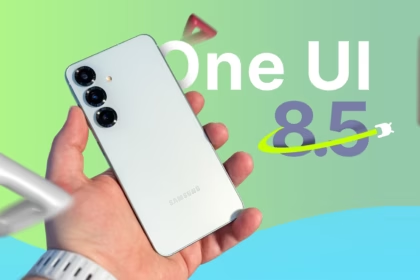
For One UI 8.5, Samsung is making some changes this year. It is hosting a conventional beta program in six nations (the US, the UK, Korea, Germany, Poland, and India) that is not limited to Galaxy Z handsets. Which gadgets will be supported? To discover out, you’ve come to the correct spot.
Yes, the initial list is rather short. At first, only the initial three models of the Galaxy S25 series are qualified. As usual, neither the Galaxy S25 Edge nor the FE model are receiving the beta.
We’ll make sure to update this list when Samsung expands the beta program to new devices, so be sure to bookmark this site and return at a later time.
Watch the video below to learn what One UI 8.5 has to offer. For more One UI 8.5 material, visit our YouTube channel.
According to reports, Samsung has been experiencing internal conflict because it does not want to raise the starting price of its upcoming Galaxy S26 series, especially after Apple maintained the price of the iPhone 17. That objective was challenging because to tariffs, growing component costs, and the persistent DRM shortage. It appears that the business has finally made a decision, and for the time being, it intends to refrain from raising prices.
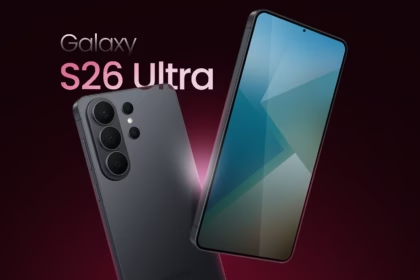
According to a Korean report (via @jukan05), Samsung will maintain the Galaxy S26’s beginning pricing at the same level as the Galaxy S25. Accordingly, the S26+ and S26 Ultra will retail for $999 and $1,299, respectively, while the entry-level S26 will start at $799.
It appears that this decision will reduce the company’s profit margins by 10% to 15%, although the strong margins in DRAM and NAND would help counteract the effect.
Most likely, only the US market will be subject to the price freeze. Due to the weakening value of the Korean won, Samsung will mostly raise prices in its home country of South Korea. European and other Asian markets may possibly see a comparable rise.
It would be the fourth year in a row that Samsung has avoided raising the price of its flagship phones if it is able to maintain pricing.
According to the source, the Galaxy Z Fold 8 and Flip 8, which are scheduled to come later in 2026, will also be subject to the price freeze.
Although not stated, Samsung’s decision to maintain the price of its flagship phones and foldables for 2026 was probably influenced by Apple’s choice to maintain the pricing of the iPhone 17.
Since it is widely anticipated that Apple will release its first foldable iPhone this year, the Korean company cannot afford to run the risk of alienating consumers with a price increase.
Expect higher prices for upcoming mid-range Galaxy A phones
However, it appears that Samsung will raise prices of its mid-range Galaxy A phones. These models’ lower profit margins provide company little to no leeway to absorb the sharp increase in component costs.
Unfortunately, there won’t be any significant hardware enhancements to go along with the price hike. Therefore, the majority of buyers will ultimately pay more for no discernible improvement. Unfortunately, the majority of phones released in 2026 may just follow this pattern.
In the battery war, the Huawei Mate 70 Air has defeated the iPhone Air and the Galaxy S25 Edge. The gadget has performed exceptionally well in the area where most brands attempt to make compromises in favor of appearance, although it may be a few millimeters behind in the battle for slimness.
One of the device’s most crucial components is the battery. If it’s a decent one, you won’t have to worry about using a charger for a few days. However, a low-density cell hinders your enjoyment in addition to using more power.
Samsung and Apple devices have excellent features and specifications. However, the battery life is something that these firms are continuously working to improve.
Huawei Mate 70 Air comes with a huge battery
Apple and Samsung are unable to incorporate a higher-density battery into their top phones despite no technological limitations. The batteries of phones such as the Galaxy S25 Ultra and the iPhone 17 Pro Max are 5000mAh and 4823mAh, respectively.
Therefore, it is unrealistic to expect these brands’ thin gadgets to have larger battery capacities. Slimness frequently results in less space for the device’s internal parameters.
Therefore, in order to achieve that ideal tiny profile, tech manufacturers must either reduce the battery capacity or other specifications like camera sensors and more.
It’s interesting to note that the Huawei Mate 70 Air has demonstrated to the manufacturers of the iPhone and Galaxy that a handset can still have a huge battery while still maintaining its thin form.
A 6500mAh ultra-thin silicon-carbon anode battery powers the Mate 70 Air’s remarkable battery life. Additionally, it offers a 66W fast cable charger that quickly charges the tablet without interfering with your video or gaming.
As a result, the Huawei Mate 70 Air smartphone offers flagship-quality battery life in addition to a fully functional experience. You can choose between a thin model with a full power pack or one that is only skinny.
Along with yesterday’s Google Black Friday sale, which featured the Pixel Watch 4 at up to $100 off and the Pixel 10 and Pixel 10 Pro lines at up to $300 off, the early Samsung Black Friday bargains and Amazon offers are already in full force. However, today’s 9to5Toys Lunch Break has even more to check out. The Samsung Galaxy Watch 8 is currently available for $280 during Black Friday, while the Galaxy Z Fold 7 can be purchased for up to $400 and the Galaxy S25 Ultra for $350.
These deals also coincide with the current OnePlus Black Friday sale, which gives up to $200 off many of the company’s most recent releases, a new Amazon all-time low on the Nothing Headphone (1), and up to 52% off a variety of Samsung monitors. Take a look at everything below.
Official 2025 Google Black Friday Deals Go Live: Big Savings on Pixel Watch 4, Pixel 10, and More
Samsung Galaxy Watch 8 Black Friday deals now live from $280
With massive price reductions on its most recent Galaxy launches, including $400 off the Galaxy Z Fold 7 and $350 off the flagship Galaxy S25 Ultra, Samsung’s official Black Friday week is already underway. However, this also means that the most reasonably priced current-generation Galaxy Watch 8 is currently available for $70 off the retail price thanks to Black Friday promotions.
Although we were able to get select Galaxy Watch 8 combinations at Woot for $100 off, there weren’t many color options available, and the bargain didn’t come with a valid warranty. However, as of right now, Samsung has reduced the price of all configurations by a significant $70:
With the exception of the Woot offer and YMMV/EDU reductions, the prices we are seeing below are, as compared to Amazon, the lowest straight-up cash discounts since release. The lowest prices we have seen on Amazon are obtained by matching these deal prices.
Check out our Black Friday Samsung coverage below, as well as the $350 price reduction on the flagship Galaxy S25 Ultra:
The official Black Friday sale for OnePlus has begun. The company told us that their major event sale is currently underway, with sales anticipated to continue through Cyber Monday if inventory permits. With the exception of the brand-new OnePlus 15, which is now in a launch holding pattern, almost everything in the sale is now down even more than we saw during Prime Day and the Halloween event, with savings of up to $200. This covers all of its most recent launches as well as a few new low-end devices, such as the OnePlus Watch 3 (43mm) and OnePlus Buds Pro 3. Take a look at everything below.
This time, promo codes are required; everything is simply marked down and operational. In addition to one of the greatest cash discounts to date on the OnePlus Pad 3 at $120 off, we are looking at outright $200 price reductions on OnePlus 13 variants.
Just be sure to keep an eye out for the free gifts that are offered on certain items; scroll down on the corresponding listing pages to make sure you take advantage of the freebies when you can:
Despite premium pricing starting at $399 for the most recent Series 10, the Apple Watch continues to lead the smartwatch market in terms of health tracking accuracy and ecosystem integration. At a tenth of Apple’s pricing, Samsung’s Galaxy Watch 7 offers comparable health indicators, AI-powered insights, and sophisticated sleep tracking. Amazon recently reduced the watch’s retail price from $249 to a record low of $129 for Black Friday. Even older Apple Watch models are undercut by that roughly 50% discount, but you get tech that Samsung discreetly introduced earlier this year.
One of the greatest deal for Galaxy Watch 7
Galaxy Watch 7
Looking for a great way to bring out your personal best every day. Challenge yourself to excel on your next run or bike ride using tracking with Galaxy AI that lets you compare your current performance to your last one
By examining yesterday’s activities, sleep quality, heart rate patterns, and recuperation indicators, the Energy Score determines your daily physical preparedness. This AI-powered study determines whether your body is ready for strenuous work or requires relaxation and lighter pursuits. Every morning, the score is updated based on the data gathered overnight, giving you useful information before you schedule your workout for the day. Samsung’s AI evaluates that data on the associated phone instead of in the cloud, protecting health information while offering tailored suggestions. As it gathers more information about your distinct physiology and reaction to varying degrees of activity, the system gradually learns your habits to improve accuracy.
Performance tracking shows you exactly where you’re maintaining, improving, or falling behind your pace by comparing your current run or bike ride to previous sessions in real time. Instead of discovering afterward that you performed poorly, you may adjust your effort during a workout thanks to the real-time feedback. In situations where a person’s arms are swinging or vibrations affect sensor contact, the Galaxy AI improves accuracy by eliminating movement aberrations from exercise users’ heart rate measurements.
Sleep tracking monitors your sleep cycles and looks for trends that indicate poor sleep quality or potential health problems. For instance, the watch is as accurate as specialized sleep tracking equipment at identifying light sleep, deep sleep, REM stages, and intervals of waking throughout the night. After that, Samsung’s AI evaluates the information to offer suggestions for enhancing sleep hygiene, changing bedtime schedules, or altering nighttime routines that obstruct restful sleep. By tracking breathing disturbances and oxygen levels while you sleep, the sleep apnea detection feature looks for mild and severe cases.
Using the sophisticated health information your watch collects throughout the day, wellness tips offers tailored advice. Its AI analyzes heart rate trends, activity patterns, stress levels, and sleep quality to find areas where little adjustments could improve general wellbeing. Such guidance touches on individual physiological reactions and real-life behavior in addition to generic fitness. When the system detects accumulated sleep debt, it may suggest earlier bedtimes, offer stress-reduction strategies during particularly stressful weeks, or motivate users to walk more on days when they are primarily inactive.
Smaller wrists can easily accept the 40mm case size without the bulk that comes with larger smartwatches. Without the need for cellular service, which raises monthly costs, Bluetooth connectivity maintains a steady connection to your phone for calls, notifications, and data syncing. The battery lasts for a full day and night of continuous health monitoring, while the precise amount of time depends on the features you activate and how frequently you use the watch.
Although some features require Samsung hardware for full performance, Samsung’s ecosystem integration works well with Galaxy phones as well as other Android devices and even iPhones. You can prioritize which health measures are displayed prominently by using the watch face customization options. This allows you to change the display to show the data you truly care about instead of generic layouts.
Samsung’s most recent wristwatch technology is available for almost half the cost of entry-level Apple Watch devices, which do not provide comparable AI-powered health insights, at $129. This 48% cut makes flagship health tracking affordable for people who have been priced out of the smartwatch market by Apple’s premium positioning.
Galaxy Watch 7
Looking for a great way to bring out your personal best every day. Challenge yourself to excel on your next run or bike ride using tracking with Galaxy AI that lets you compare your current performance to your last one
Samsung has begun discussing its first 2nm chips in public, and the figures are unexpectedly modest, which is causing some people to take notice. The business plans to begin shipping the new silicon in 2026, beginning with the Galaxy S26 series in Europe. Although the upgrades don’t seem like a “revolution” on paper, they are already helping Samsung earn large contracts and higher expectations.
Samsung’s worldwide flagship strategy has been weak for years due to its Exynos chips. Customers in Europe have frequently received slower, less effective devices than their Snapdragon-equipped counterparts in the US, and it appears that the S26 and S26+ will follow suit. While the S26 Ultra is expected to continue using Qualcomm’s Snapdragon 8 Elite Gen 5 globally, those two variants are anticipated to employ the Exynos 2600.
Exynos 2600 performance boost
Samsung appears confident, though. According to the company’s most recent financial report, the new 2nm Gate-All-Around (GAA) process is expected to improve performance by around 5%, increase efficiency by 8%, and reduce chip size by about 5% when compared to its second-generation 3nm process. Those figures are not that large on their own. However, they are already paying off. Based on early 2nm capabilities, Samsung reportedly acquired about 25% of Galaxy S26 orders and a huge $16.5 billion contract with Tesla for its AI6 CPUs.
Another aspect of the jigsaw is yield. According to Samsung, the Exynos 2600 is currently achieving a yield rate of over 60%, which is supposedly sufficient to begin significant production. In comparison to employing Snapdragon chips, the company might save $20–$30 per unit if that remains true, which could result in a significant reduction in the bill of materials (BoM) for the European S26 models.
However, not everyone believes that this is Samsung’s desired return. Exynos has a lengthy history of appearing promising on spec sheets but faltering once the phones are in the hands of consumers. Additionally, there is still a fundamental design gap: Samsung continues to use ARM’s standard Lumex core designs, which typically lag behind in real-world optimization, while Qualcomm and Apple develop highly customized CPU architectures.
The question is rather straightforward as the Galaxy S26 debut draws near: is Samsung’s early 2nm jump a real turning point or is it just another case of déjà vu for European consumers? It’s obvious that the corporation believes little steps will build up. It’s another matter entirely if consumers concur.
One excellent watch is the Google Pixel Watch 4. You could even claim that it’s the greatest Wear OS watch of the year. It’s about as complete a package as you could wish for, with its new Acuta 360 display, extended battery life, enhanced repairability, and superb Gemini integration.
If you’re currently shopping for a smartwatch, it’s important to remember that there are other options available, even if we highly recommend purchasing the Pixel Watch 4. Actually, there are actually a ton of alternative fantastic timepieces that you ought to think about.
Even if we adore the Pixel Watch 4, you might want to consider these five other smartwatches.
Google Pixel Watch 3
The Google Pixel Watch 3 is designed for performance, with advanced fitness from Fitbit; the 45mm screen is twice as bright and 40% larger than before, making it easier to see your stats and info
The Pixel Watch 3 from last year is the best option if you believe the Pixel Watch 4 looks fantastic but can’t afford to spend more than $350 on it. Is it as remarkable or beautiful as the Pixel Watch 4? No, but you can now purchase it at a fantastic price, and it’s still a really fine smartwatch.
As someone who still wears a Pixel Watch 3, I can assure you that it’s well worth the money if you want to enjoy the Pixel Watch experience without going over budget. Its screen still looks amazing even though it lacks the latest Acuta 360 display. Its battery life is still sufficient for a full day of use, it has already been updated to the same Wear OS 6 software as the Pixel Watch 4, and its health-tracking functions are the same as those of the Pixel Watch 4.
OnePlus Watch 3
Unmatched Battery Life: Experience up to 120 hours of uninterrupted use on a single charge.
Easily lasting a day and a half on a single charge, and occasionally even two full days, the Pixel Watch 4 has the longest battery life of any Pixel Watch to date. However, the OnePlus Watch 3 is a superior choice if you place a high value on battery life. Why? due to the fact that one charge might last up to five days. That’s right—five days on a single charge.
At that point, all of the OnePlus Watch 3‘s smartwatch functions are activated. You can get closer to two weeks of use before you have to find your charger if you switch on power-saving mode. The OnePlus Watch 3 has some of the fastest charging rates of any wristwatch, moving from 0% to 100% in roughly 30 minutes when the watch does eventually die.
Nevertheless, there are several drawbacks to this kind of battery life. Although the OnePlus Watch 3’s fitness and health features are useful for everyday use, they fall short of those of Samsung or Google. The OnePlus Watch 3 is a large smartwatch as well. It is available in a smaller 43mm size, however the battery life is reduced, which somewhat contradicts the point.
I believe you will be quite pleased with the OnePlus Watch 3 if you don’t mind the size and don’t require the most advanced fitness monitoring. Additionally, it is slightly less expensive than the Pixel Watch 4 at $330.
Fitbit Charge 6
COMPLETE ALL-IN-ONE-BUNDLE: Includes Fitbit Charge 6 Black/Obsidian, rapid USB charger, and a premium microfiber cleaning cloth, – everything you need to start tracking in style.
I am aware that this isn’t a smartwatch in the traditional sense. However, I believe there is a compelling case for the Charge 6 as a Pixel Watch 4 substitute.
With the exception of the subscription need, Fitbit is a very powerful health platform, and the planned makeover of the Fitbit app only seems to improve it. The Charge 6 is a far more cost-effective entry into the Fitbit ecosystem than the Pixel Watch 4 if you already have a lot of data in the Fitbit app from prior devices or if you’re just getting started.
The Fitbit Charge 6 offers many of the same health tracking features as the Pixel Watch 4, including all-day activity tracking, sleep tracking, irregular heart rhythm notifications, ECG scanning, SpO2 tracking, a skin temperature sensor, and more, despite lacking the Play Store, Gemini, call screening, LTE, and other smart features. In addition, the seven-day battery life is fantastic and the compact size is really comfortable.
The finest aspect? The Fitbit Charge 6 is only $160 at retail, and it’s frequently on sale for even less.
Samsung Galaxy Watch 8
WHY GALAXY WATCH8: Advanced health and sleep tracking features. A lighter, more snug design for all day comfort. Improved user interface. Personal AI assistant for hands free help.
You might be better suited with the Samsung Galaxy Watch 8 if cost isn’t a concern but you want to think over other options before committing to the Pixel Watch 4. The Galaxy Watch 8 may be a better option for some of you reading this, but it starts at the same $350 as the Pixel Watch 4.
The Galaxy Watch 8’s extensive health tracking suite is one of its best features. The new Running Coach tool really helped me improve as a runner this summer, and Samsung’s Energy Score is a great way to understand how prepared your body is for the day. Samsung’s activity monitoring is excellent, the Samsung Health app is incredibly well-designed, and its sleep tracking is among the most reliable for Wear OS. The finest aspect? In contrast to Fitbit on the Pixel Watch 4, Samsung Health offers all of its health functions without requiring a monthly subscription.
Furthermore, the Galaxy Watch 8 is not limited to health tracking. The smartwatch’s AMOLED display is stunning, its watch band system is far simpler than the Pixel Watch 4’s, and it is incredibly comfy.
When it comes to battery life, the Pixel Watch 4 is superior, and the Galaxy Watch 8’s absence of a digital crown or rotating bezel is a drawback. However, the Galaxy Watch 8 is a great option if you have a Samsung phone or don’t want your watch to come with a monthly subscription.
Garmin Venu 4
Garmin Venu 4, 45mm, Advanced Health and Fitness GPS Smartwatch, Silver with Silver Gray Silicone Band + USB3.0 to type-c female adapter Space Gray + USB Wall Charger + 6Ave Microfiber Cleaning Cloth
The OnePlus Watch 3 has outstanding battery life, but the Galaxy Watch 8 is a fantastic option if you’re looking for a wristwatch with subscription-free health tracking. You might want to think about the Garmin Venu 4 if you’re looking for a Pixel Watch 4 substitute that offers both of those features.
The Venu 4‘s most notable feature is that it runs Garmin’s proprietary operating system rather than Wear OS. Notifications, phone calls, offline Spotify downloads, and a Google Maps app are just a few of the standard wristwatch features you still have, but you are unable to access the Play Store or Gemini.
Garmin claims that the Venu 4 may be used for up to 10 days on a single charge, making it the watch with the longest battery life on this list. In addition, the Garmin Venu 4 has a beautiful metal design, 41mm and 45mm size variants, and an integrated LED flashlight.
The starting price for all of this is $550, which is a lot more than the Pixel Watch 4. However, the Garmin Venu 4 might be worth the cost if you’re looking for a well-made smartwatch with superior fitness tracking and a long battery life.
Samsung is already rolling out One UI 8, its version of Android 16, to all Galaxy phones that support it, but the upcoming major update may be much more important.
At least four new Galaxy AI functions may be included in One UI 8.5, according to a report from the Korean website ETNews.
But you may have to wait a long time. The Galaxy S26 series phones are expected to get OneUI 8.5 in January or February 2026, with a broader rollout to follow in the coming weeks and months.
They would be the first new Galaxy AI features in more than a year, if that is the case. Here is what you have to look forward to.
Meeting assistant
Has somebody ever met with you using a language you don’t understand? I’m not referring to ROIs and KPIs, though Galaxy AI might be able to assist you with that as well—a real foreign language.
Meeting Assistant was created with certain situations in mind. Theoretically, it can identify what is being spoken, precisely transcribe it, and then translate it in real time into your target language. If all goes according to plan, this may be quite helpful in some meetings, as well as in situations like interviews and press conferences, if you connect headphones.
Touch assistant
Similar real-time translation capabilities are provided by Touch Assistant, but only for text that is displayed on the screen. You can choose to translate a passage of text by simply selecting it as though you were going to copy it.
Although it’s unclear exactly what this means, ETNews claims that Touch Assistant also “organizes it for easy reading.”
Smart clipboard
You can move text without being restricted to the most recent item you copied by using the clipboard feature, which is available through the Samsung Keyboard.
By employing AI to recommend actions for any material that shows up, Smart Clipboard seeks to improve this. For instance, you could want to add particular words or phrases to your favorites, summarize a lengthy text section, or translate anything that isn’t in your system language.
Social composer
Do you like sharing content on Instagram but find it difficult to think of a clever caption? Social Composer can assist you.
It can analyze your uploaded photos, identify the people or things in them, and then provide a variety of textual descriptions about them. Along with a more thorough description and even links to any products it recognizes, this can also include a caption.
A big Galaxy AI leap for free?
Whether all of these capabilities will be available on One UI 8.5 in the format ETNews has outlined is still up in the air.
It could, however, significantly improve the Galaxy AI experience on your phone. Will it be able to match the Google Pixel phones’ Gemini-powered experience? We’ll find out in time.
Additionally, Galaxy AI might not always be free, even though Samsung has not indicated that it will charge for certain services.
Although the One UI 8 update is already available for a large number of Samsung Galaxy phones, some models have a different situation. Samsung has put impacted users at risk by formally discontinuing software support for a number of devices. What that entails for Galaxy owners is as follows.
Samsung recently posted the most latest software schedules for Galaxy devices on its support page. Notably, some models now receive security upgrades every three months instead of every month. This includes the low-cost flagship Galaxy S21 FE, which will no longer receive monthly security fixes but rather three-monthly ones.
Android 16 via One UI 8 is still scheduled to be released for the Galaxy S21 FE in the upcoming weeks. It won’t receive Android 17 or One UI 9 next year because this will be its last significant update. Samsung might still release One UI 8.5, though, and it will probably be based on Android 16.1.
Final update rolls out to these Samsung Galaxy phones
The mid-range Galaxy A52s and low-cost Galaxy A03s have been taken off the support page as devices that are on the chopping block. June of this year saw the most recent security update for both. They won’t receive the September or October patches, based on their removal. The Galaxy F42 and M32 are also no longer on the list.
The Galaxy Tab A8, which was released in early 2022, might be the next in line. By the end of this year or January of the following year, it might get its last update.
These Samsung may be at risk
These devices will lose out on important security updates that guard against changing cyberthreats, even if they might still get software updates and small patches from the Google Play Store. Outdated devices are more susceptible to assaults that could jeopardize personal data or even result in financial loss if these patches are not installed.
The September security update, for example, fixed a number of vulnerabilities, including a number of high- and medium-severity problems. There have been reports of some of these being used in the wild.
Because risks are constantly changing, regular updates are crucial. Up-to-date software is just as important for staying safe as new hardware.
Upgrading to a newer gadget is the easiest solution for impacted consumers. Although it is feasible to keep using unsupported phones, users should be aware of the hazards. One strategy to lessen risk is to steer clear of banking and financial apps on mobile devices.